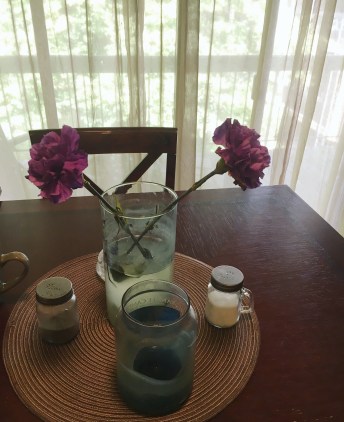
I am about to reveal something kind of weird about myself. At least, I think it’s weird but maybe everyone else does it too; I’ve never asked. Whenever I get flowers from someone, a nice bouquet from the store or a farm stand, or even a bunch that were hand-picked, I put them in a vase and keep them healthy for as long as possible. That part is normal. But as the flowers die and dry up, even down to one single bloom, I only toss the dead stuff. I absolutely cannot bring myself to throw out even one still-vibrant flower along with the dead, dry remains of the others.
Case in point: the remaining two blooms from the giant bouquet (see size of vase, which was selected when I first got them) which I received a couple weeks back, as pictured in the photo. I just can’t bring myself to throw them out. I know it’s easier to just throw out the whole bunch once the majority start to droop, but to me it’s worth the sifting, sorting, and even cleaning up the mess of petals which inevitably fall from the dead flowers as I’m juggling and picking through to get to the good ones.
As I was sifting this morning, I had a few different thoughts resulting from this quirk of mine.
Firstly, the Lord specifically tells us to focus on the good things, to cling to His word, and to pursue righteousness. And also to dispose of the junk, the ugly, the sin. To allow His Spirit to move in us so that we live a more Christ-like life for His glory. There’s additions and subtractions, both, which take place in the life of a believer once they accept Jesus and give their life to Him. Philippians 4:8 tells us, “Finally, brothers and sisters, whatever is true, whatever is noble, whatever is right, whatever is pure, whatever is lovely, whatever is admirable–if anything is excellent or praiseworthy–think about such things.” Galatians 5:22-23 tells us that, “The fruit of the Spirit is love, joy, peace, forbearance, kindness, goodness, faithfulness, gentleness and self-control. Against such things there is no law.” Romans 12:9 says, “Hate what is evil; cling to what is good.” 1 Peter 2:1-3 reads, “So get rid of every kind of evil, and stop telling lies. Don’t pretend to be something you are not. Stop wanting what others have, and don’t speak against one another. Like newborn babies, you should long for the pure milk of God’s word. It will help you grow up as believers. You can do this now that you have tasted how good the Lord is.” We are told not only to take off the bad stuff or to put on the good stuff; we are told to do both. We are told that the Lord can absolutely help us with both sides on the coin of Christian life. We cannot serve two masters, though we don’t become perfect once we start living for the Lord. That said, we can ask the Lord to sift through all the parts of our soul, to find the redeeming pieces and create a new bouquet of our lives. Unlike the example with my flowers, God doesn’t just pick out the dead stuff and leave it be, with only two inevitably fading blooms remaining. No, He also adds in the most vibrant, gorgeous, alive blooms through His gifts and graces and fruits of His Spirit. Out of His endless love for us when we offer willing hearts, He also takes our two decent blooms and transforms even those into something much better, more alive. Forever alive, in fact.
Secondly, God Himself has done, and is doing, exactly what I have done so many times with my flower bouquets. I immediately think of how in Genesis 18, Abraham countered with God several times on behalf of Sodom, which the Lord was planning to destroy. It got down to the point at which God agreed that, if even just ten righteous people could be found in the entire city, He would not destroy it. But even ten could not be found. Yet the Lord made sure to provide a way out for the few righteous who remained (Lot, his wife and his two daughters) as He sent angels to warn them to get out of the city before the Lord destroyed it. That’s a pretty major bouquet sifting! He couldn’t bring Himself to destroy even a few righteous despite the entire city being spiritually dead and abhorrent. He plucked them out, and tossed the junk.
I also think of Jeremiah 5, which I read just the other day, in which the Lord talks about His plan to bring His wrath upon Jerusalem, which had turned to false gods even to the point of sacrificing their children in fires and killing other prophets of the Lord. In Jeremiah 5:1, the Lord says, “Go up and down the streets of Jerusalem, look around and consider, search through her squares. If you can find but one person who deals honestly and seeks the truth, I will forgive this city.” Jerusalem had gotten to the point where it was worse than even Sodom and Gomorrah had been! God’s chosen people, His chosen place… I can’t even imagine the blow that was to such a faithful, redeeming God who had offered and given so many fresh starts, opportunities to return to Him, proven Himself over and over. The Lord determined not to bring his wrath for the sake of even one! For even one bloom He could not dispose of the dead, reeking bouquet.
In Matthew 18:12-14, Jesus offers the parable of the lost sheep. He says, “What do you think? If a man owns a hundred sheep, and one of them wanders away, will he not leave the ninety-nine on the hills and go to look for the one that wandered off? And if he finds it, truly I tell you, he is happier about that one sheep than about the ninety-nine that did not wander off. In the same way your Father in heaven is not willing that any of these little ones should perish.” 2 Peter 3:9 adds, “The Lord is not slow in keeping his promise, as some understand slowness. Instead he is patient with you, not wanting anyone to perish, but everyone to come to repentance.” The Lord does not delight in the tossing of the dead things when the dead things are souls hardened to Him despite His love. I know He wants everyone to experience the incredible joy and love that is only found in Him, but He is also discerning and just and jealous and righteously indignant. He is a God capable of inflicting His wrath, a God who will go to any extent to draw His people back to Him, a God to both love and to fear. With the Lord’s help, I can become a bloom that doesn’t wither or fade because I am living for Him. I can become a bloom which He will preserve on the day of reckoning. A bloom forever in His heavenly vase.
Lastly, my bouquet plucking made me reflect on how I view myself and others compared to how God views us. The metaphor here being that we are each a bouquet, with many, many bits of stuff comprising who we are as a whole. And every single one of us has dead pieces that should be tossed. Me, you, your angelic grandmother sweet as pie. And we have some serious issues when it comes to seeing the junk in ourselves and others. First, I think it is much easier for us to see the dead things in others, rather than to see the junk in ourselves. I also think it can be easy to see the junk in others rather than to focus on the good, beautiful parts of their beings – the few blooms embedded within the dry stuff. Thirdly, I think it is easier to just see the junk in others, or even ourselves, than to lovingly pray and encourage change for the better. Seeing is one thing… but once we become aware, action must take place if we are serious about living for the Lord, about fighting the good fight. That is true in regard to when we become aware of junk in our own bouquet or in that of another. Anyone can see the flaws in others; it is a gift to help them see the dead pieces for what they are, to help them focus on the healthy parts of themselves while removing the junk, to be the Lord’s hands as He sifts and adds and recreates the entire bouquet of their being. In fact, I would rather not even see the ugly in someone unless the Lord intends for me to either help them toward His beauty, or to draw closer to Him myself because of it. Awareness can lead to judgment… and I don’t think that’s why God calls things to our attention. But awareness can also lead to conviction, correction, prayer, and change. Those are the reasons I think God calls those things to our attention. In regard to both ourselves and others. We are not supposed to ignore the dead pieces, but we can also celebrate the healthy, beautiful blooms despite them – in ourselves, in others, in life. And we can pray and work toward the dry, flaky, withered junk being done away with, no longer interfering with the fragrant scent and image of a life lived for God’s glory.
At the end of the day, hold onto the beautiful. For some it may not be easy, but it is worth the extra effort.
1 Peter 1:24-25, HLC
 sacred strokes
THANK YOU!
LikeLike