I was reading Matthew this morning and a segment of chapter 21 provoked me to so much thought and reflection, that I had to write about it for today’s post. The part I am referring to is Matthew 21:18-19, in which Jesus curses a fig tree. The verses are as follows:
“Early in the morning, as Jesus was on His way back to the city, He was hungry. Seeing a fig tree by the road, He went up to it but found nothing on it except leaves. Then He said to it, ‘May you never bear fruit again!’ Immediately, the tree withered.”
Now, I have read this quite a few times before, but today it just struck a chord with me. I remember my first encounter with this passage, when I was quite young. I remember imagining some small, cute little fig tree (think Charlie Brown Christmas tree level of pathetic adorableness) that was struggling just to get by. Then, Jesus gets mad at the little thing and curses it, causing it to die and shrivel. I remember struggling to understand how Jesus could be mean or spiteful to even a tree. It doesn’t align with how I viewed Him and who I knew Him to be.
Of course, I wasn’t understanding the deeper meaning behind this passage. The message it sends to all of us. Firstly, and maybe I’m reading into this but perhaps not, Jesus saw the fig tree and went up to it, as he was hungry and expecting some fruit. You know what this tells me? That the fig tree was full and healthy and perfectly capable of bearing fruit, or else Jesus could have seen, even at a distance, that it was not able to produce figs. He didn’t know it was fruitless until He came close to it, right up to it. So, that immediately changes my younger self’s concept of a small, cute, little Charlie Brown Christmas tree- type fig tree. That thing was full grown and healthy and should have been producing fruit. That kind of changes the picture, doesn’t it?
Secondly, Jesus was hungry. He needed sustenance to continue His mission. He naturally approached the fig tree He saw, so that he could eat from it. And the fig tree came up empty-handed. Of all the times that it would have been important to produce fruit, to do what it was literally designed (and by Him!) to do, it failed Him. The Lord had bestowed everything necessary for this fig tree to flourish and produce a harvest, but it still didn’t have even one fig to show for it. Not even at the moment it mattered most.
Thirdly, the text does not say that Jesus became angry. He may have been. We all know what hangry feels like. But perhaps even more prevalent was the feeling of disappointment. He had traveled to the tree, sought it out specifically, expecting pleasing nourishment, only to find a complete lack of anything worthwhile. A complete lack of concern for Jesus and for His desires. If that tree could not produce fruit for its Creator, its Provider, its Sustainer, Jesus ensured that it would not produce at all. In fact, He destroyed it. True fruit, good fruit, real fruit is always produced with the Lord’s help and for His glory. He had provided what it needed to yield figs, but that tree didn’t care about serving Him at all.
Of course, we can easily become like that fig tree. That’s the whole metaphor here and probably why that fig tree was barren in the first place – so that we can learn from it, even today! Like the fig tree, we can easily begin to neglect what Jesus is asking of us. We can forget that fruitfulness is evidence of the Lord’s Spirit in us. We can become complacent and lukewarm in a world where it is so much easier to just settle into worldly contentedness than to pursue godliness and chase after the Lord with all we’ve got. We can show up empty-handed in the very moments that God needs us most to be His agents and support squad here on earth. We can let down our Savior, the very one who has gifted us with our skills, talents, and sustenance, and rather use all of those things for our own selfish purposes. We can grow outwardly healthy and beautiful and lush, but still lack fruit, lack those things which truly matter and which the Lord is asking us to disburse throughout this world as sustaining, life-giving nourishment.
I do not want to be like that fig tree in Matthew 21. I want to be like a fig tree that, when Jesus comes up to me expecting fruit, I am able to offer Him many. I want Him to tell me, “Well done, good and faithful servant” as he realizes that I have been working to produce fruit in preparation for His arrival. I want to be like the first servant in the Luke 19:11-27 parable who was given one mina and earned for his master tenfold. I hope that my fruits are many. I hope that, rather than coming to Him all alone, I am bringing many others with me. I want Him to commend me, like the master does in that parable, “Well done, my good servant!” I want to live to please Him.
If you were a fig tree, how would Jesus find you? If you were on the side of the road and He was searching for fruit, would you be able to offer any, few, or many? This life is a gift, and not meant to be fruitless.
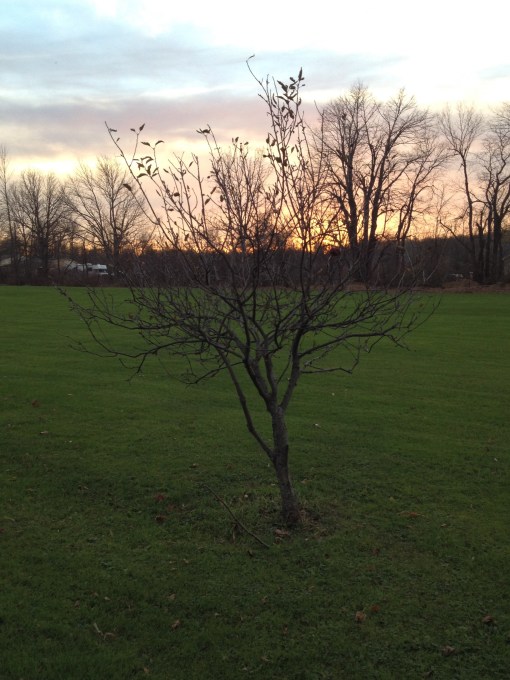
(P.S. That photo up top is of a small apple tree at my dad’s house. I took the photo a couple years ago. If you zoom in, you will see one lone apple in the top, rightish area of its branches. Even that small little thing mustered enough to produce a beautiful and perfect fruit. We have no excuse.)
Galatians 5:22-26, HLC
 sacred strokes